
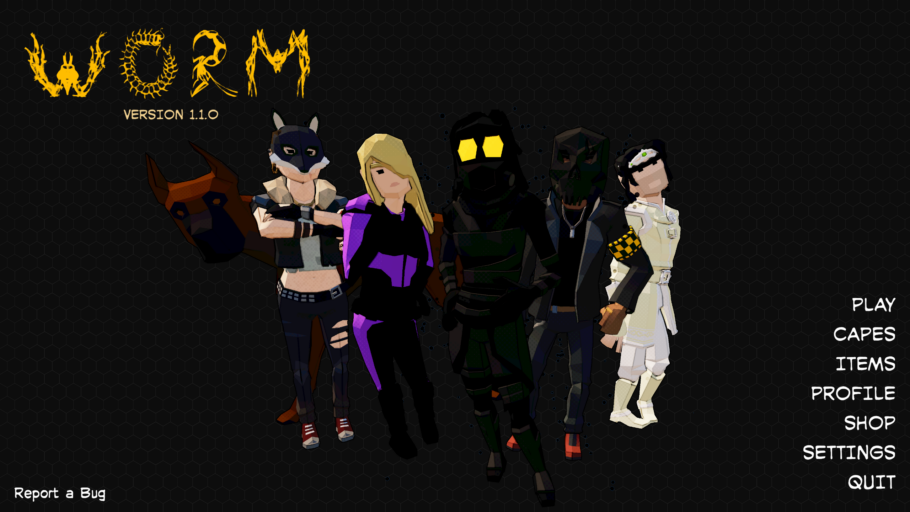
I’ve been keeping quite busy these past several months! Since I last updated this website in March, I’ve been hard at work on two major projects:
- An overhaul of my MOBA, Worm, touching just about every aspect of that game (the graphics, the UI, the matchmaking, the maps).
- A digital trading card game set in the world of Badly Lit Spirits. I started it a while ago (it’s on my Future Projects page), but as of now I’ve gotten much, much further on it.
Neither is quite ready to play just yet, but they’re both very close and I hope to have them completed fairly soon. In the mean time, here are a few sneak peeks!
Worm
Last March, I called Worm a finished project, and the version that has been available since then is indeed a complete, fully playable game. However, I’ve come a long way as a developer since 2021! There were a lot of things I knew I could improve, and I was excited to come back to an old passion project with a fresh perspective. So I set about working on a complete overhaul of Worm, which is coming along nicely. Here are some of the highlights.


Graphical Overhaul
My main goal in updating Worm‘s graphics was to make the look and feel of the game more evocative of a superhero comic book, as befits the source material. To showcase this, here are a few before-and-afters: one of the Cape Select screen and one from in game. Both have changed considerably. The color-grading is much sharper, and the lighting is cel-shaded. Characters and props are outlined in black as if hand-drawn, and there’s a dithering effect in the darker areas of the scene to suggest the texture of paper.
Accomplishing these effects required working with Shader Graph, which in turn required me to upgrade Worm to utilize Unity’s Universal Rendering Pipeline. This in turn broke a lot of other things, such as the vision system (which controls what a player can and can’t see at any given time and lightens only the areas within line of sight), so getting everything working again ended up being a significant undertaking.
I also updated or replaced several models and particle effects that didn’t fit stylistically.
UI and UX Overhaul
The user interface didn’t really match the genre of the game either, so I redid that completely too. It’s been redesigned to be sleeker, flatter, and utilize comic-book fonts throughout. It should also be significantly more usable. I took the opportunity to make a number of quality-of-life improvements:
- A minimap showing your location and the location of any cape you have vision on. You can click a point on the minimap to jump there.
- The camera is rotatable so it’s easier to see around walls, and it can no longer scroll past the boundaries of the map.
- Ability icons are clickable. It’s still usually more convenient to use the hotkeys, but as the icons do look like buttons I wanted to make sure that they behaved as one would expect. Hotkeys are also much more clearly labeled.
- Single-target abilities now actually look at what your mouse is directly over rather than looking at the ground underneath your mouse, making them significantly more intuitive to aim.
- …and many more small tweaks and changes to make the experience smoother and more intuitive to play.


New Lobby System
Previously, you picked a map and were simply added to the first available game, meaning you had no control over who you actually played with. Now there’s an actual lobby system: you can choose to host a game, or join a specific one that’s already been created. Hosts can choose to make their games public or private; if private, a game won’t show up in the list of joinable games and players join by entering an ID provided by the host. It’s a much more robust way of getting players into a game than I had before.
Completely Redesigned Maps
I didn’t know a lot about level design when I created the original versions of Brockton Bay Central Bank and The Boardwalk, Worm‘s two playable maps, back in 2020 and 2021. I designed them to have fairly realistic layouts, which made them rather ill-suited for actual gameplay; there were rooms filled with props that had no real purpose, for instance, and the maps were asymmetrical in ways that unintentionally favored one side over the other. I wanted to start over with the knowledge that I have now, so that’s what I did; both maps have been completely redesigned from the ground up and offer a far better experience.
Cape Select has been redesigned to be more thematically appropriate too; the Parahuman Response Team now starts in a police station and the Gangs of Brockton Bay now start in a lineup, rather than the random office and bunker they respectively started at before.


Badly Lit Spirits Trading Card Game
I’ve also been working on my digital trading card game, which I previously showed off under Future Projects. It’s come a long way since then! I’ve added a variety of exciting new mechanics. Here are a few of them:

A mulligan system like that of Magic: the Gathering. You can redraw a bad hand up to seven times, but each time you do this you must put an additional card from the new hand back.
Sigils, akin to tokens in Magic; they modify the stats of cards in play for as long as they remain in play.


Tokens: cards that aren’t part of your deck but are generated on the fly from the effects of other cards.
Double-sided cards; you choose which half of the card you want to play at the time you play it. (There are also double-sided cards that always start on one side and flip when a condition is met.)


Cards can make you search your deck for one or more of a specific type of card and put what you find somewhere (in your hand, on top of your deck, etc.).
Impulse drawing: the effect from Magic where you exile one or more cards and then have a limited number of turns to play those cards out of exile. For ease of user experience, ghostly copies of the exiled cards appear in the player’s hand to make sure the player knows there is an action he or she can take.


I’ve also redesigned the entire UI for a more appropriate dark-fantasy look and feel. Here’s the new deck builder.
Tooltips are much-improved to better convey useful information to the player. If a card generates tokens, mousing over the card will also show the token. If a card uses an unexplained keyword such as Soaring or Alert, mousing over the card will show an explanation. If a card is double-sided, mousing over it will show the other side.


Locations are the main mechanical difference between my game and Magic: the Gathering. Creatures are stationed at locations to defend them; instead of attacking a player like in Magic, you attack your opponent’s locations in order to destroy them. Every turn your locations build up will score; at the end of a turn, you get the opportunity to move your creatures around as well as sanctify a single one of your locations, removing it from play to cash in on the will score it has built up. Rather than a life total as in Magic, you win by cashing in a specific amount of will before your opponent does the same. All of these mechanics are implemented already: creature combat, will score, garrisoning, sanctifying, victory and defeat, etc.
There’s quite a bit more, too: far too much to get screenshots of absolutely everything. Even having played Magic: the Gathering, which is the direct inspiration for my game, it’s astounding how many unique kinds of effects and interactions there end up being, each of which has to be accounted for. Now I see why the Magic official rulebook is over 300 pages long! Nevertheless, I’m very happy with the progress I’ve made.
Tags: Dev Diary